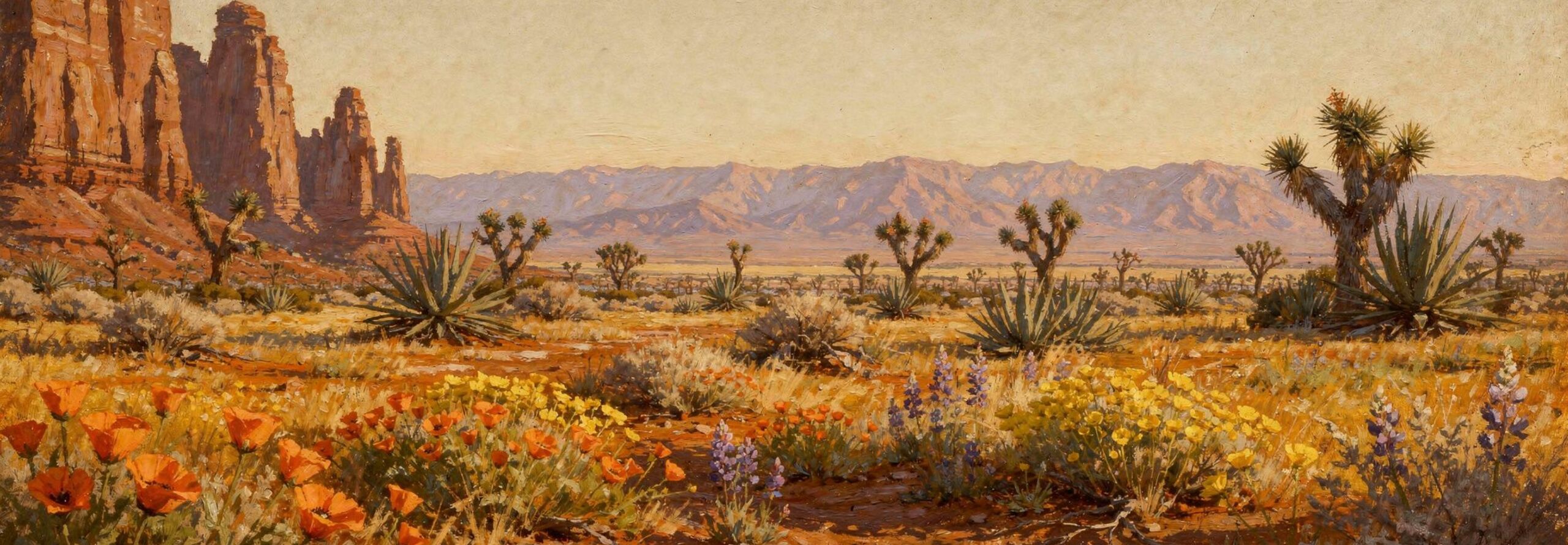
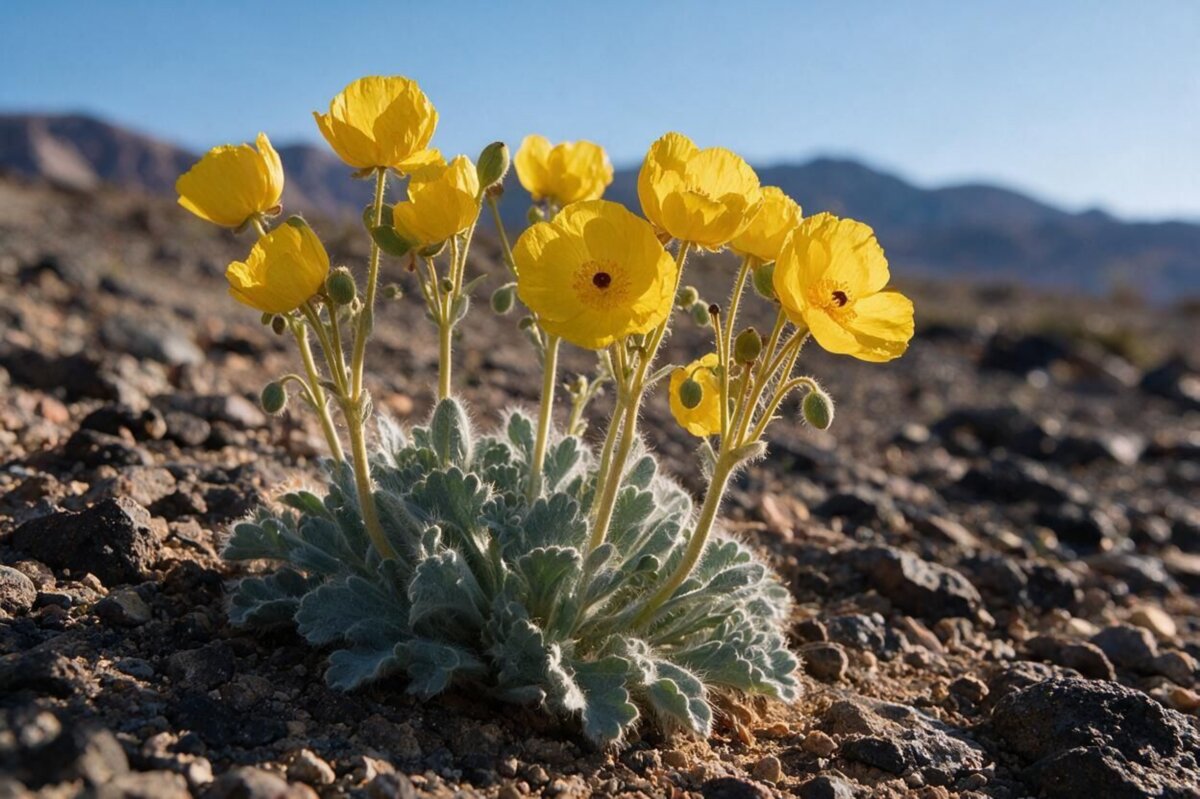
This poppy grows in gypsum — pale, mineral, punishing soil that most desert plants can't touch — and that is precisely the point: nothing else wants the ground, so the bearpoppy gets it. It lives in southern Nevada and a corner of northwest Arizona and nowhere else on the planet. Each flower opens for about two days. It shares its fate with a small bee that gathers almost nothing but bearpoppy pollen, so when one struggles, so does the other. It carries the name californica from the era when this valley was Mexican territory. It has never grown in the state of California.
Who They Are
A perennial herb of the poppy family, low and unassuming for most of the year — a basal rosette of pale gray-green leaves, densely hairy, lobed in a shape that reads convincingly as a bear's paw and gives the plant its name. In spring it sends up branching stalks a foot to a foot and a half high, topped with deep yellow flowers. Individual blooms are brief, open roughly two days before the petals and anthers detach, though the stigma stays receptive a little longer. The rest of the year it is easy to walk past without noticing. What makes it extraordinary is not the plant but the address.
Life in the Mojave
The Las Vegas bearpoppy is a gypsum specialist. It grows on gypsic and calcic soils — chalky, mineral, low-nutrient ground that is actively hostile to most plants — in southern Nevada and northwestern Arizona, roughly from Gold Butte down through the Lake Mead area, and nowhere else in the world. That's the strategy: colonize soil so difficult that nothing else competes for it, then own it completely. The trade-off is that the plant cannot leave. Its populations are pinned to scattered soil deposits, and they swing hard with rainfall — researchers documented some populations declining by over 90% between 2021 and 2022 during drought. It also has an unusually tight pollination relationship for a plant: the Mojave poppy bee, Perdita meconis, is a pollen specialist so faithful to this poppy that analyses found nearly 100% of the pollen on female bees' collecting hairs came from bearpoppy. The bee is itself in trouble and has been considered for federal protection. Two rare species, one fate.
Why It Matters
This is the plant that grows where Las Vegas is expanding. Its habitat sits on public land in the path of urban sprawl, energy development, resource extraction, and off-highway vehicle recreation, and the species has declined in recent decades. Conservationists petitioned to list it under the Endangered Species Act in 2019; in October 2024 the U.S. Fish and Wildlife Service reviewed 86 known occurrences in 12 population groups and found federal listing not warranted at this time. Nevada takes a stricter view — the bearpoppy is state-listed as critically endangered and fully protected, Arizona protects it too, and NatureServe ranks it critically imperiled. It's also a small monument to how casually things get named: the species was described by Torrey & Frémont as californica — reportedly for the Mexican territory this valley belonged to in that era — and the plant has never once grown in the state of California. If you want a single species that represents what's at stake in this specific desert — not the Mojave in general, but the ground outside Las Vegas — this is it.