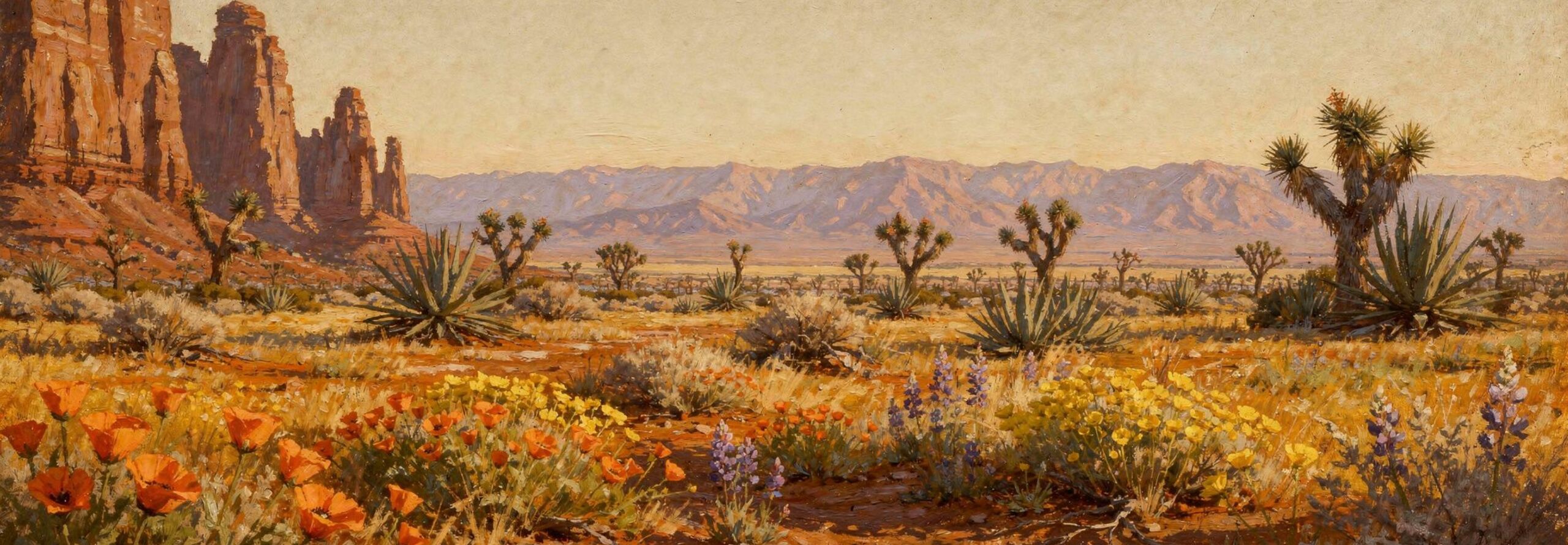
If the desert has a smell, it's this: rain hitting creosote, resin lifting off a billion waxy leaves at once. The plant itself is even more patient than it smells. A creosote reproduces by cloning outward in a slow ring as its own center dies, and one ring near Lucerne Valley — King Clone — has been doing this for roughly 11,700 years, since the Ice Age was ending, which makes it one of the oldest living things on Earth. When it was nearly lost to development, the rescue didn't come from a government agency. A local gardening club raised the money and bought the land.
Who They Are
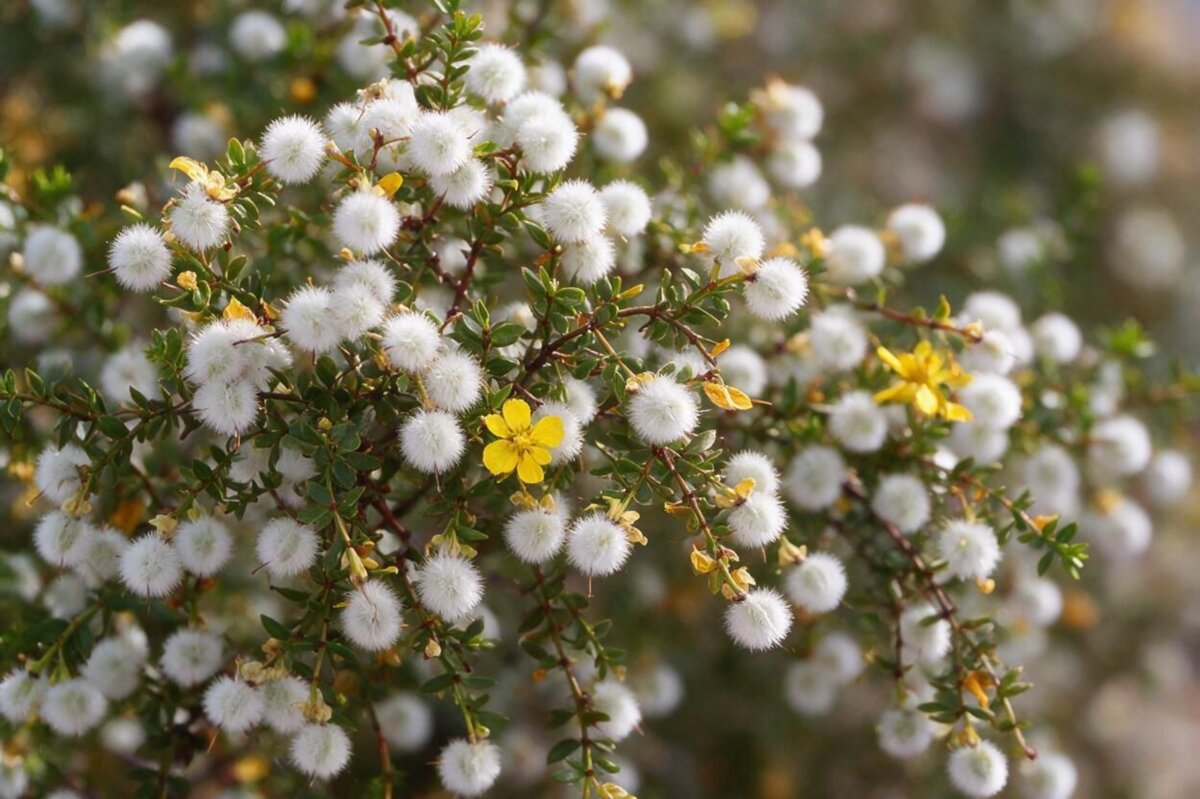
An open, olive-green shrub, usually chest- to head-high, with small paired leaves varnished in resin and, after good rain, a scatter of little yellow flowers followed by fuzzy white seed balls. It is the most common shrub in the North American deserts and the defining plant of the Mojave's flats — so ordinary-looking that most people drive past a million of them without a glance. The varnish is the giveaway. Those resins seal moisture into the leaf, make it unappetizing to nearly every browser, and produce the single most beloved smell in the desert: the sharp, medicinal sweetness that rises when rain hits creosote. People call it the smell of rain. It's the smell of this plant.
Life in the Mojave
Creosote runs a whole economy. More than twenty species of native bees feed exclusively on its flowers; some fifteen species of gall midges raise their young in swellings on its stems; kangaroo rats harvest and cache its seeds; jackrabbits browse it when nothing better offers; and the chuckwalla is the only reptile known to eat its leaves. Meanwhile the shrubs themselves keep famously even spacing across the desert floor — long blamed on the plant "poisoning the soil," but the better-supported story, worked out in root experiments published in PNAS, is an underground contest: creosote roots detect neighboring roots and win the fight for water, so seedlings simply can't establish too close. And when a creosote gets old, it doesn't exactly die. The original stem crown decays while new stems clone outward from the same root system, forming a slowly widening ring of genetically identical bushes around a bare center — one individual, renewing itself in place, indefinitely.
Why It Matters
Indefinitely is not an exaggeration. In the early 1970s, botanist Frank Vasek and colleagues noticed an oddly circular creosote ring in old aerial photos of Lucerne Valley; ground research confirmed the ring was a single genetic individual, and two independent dating methods — radiocarbon on dead wood from the center, and the ring's measured outward growth rate — converged on an age of about 11,700 years. King Clone, as it's now called, germinated as the last Ice Age ended and has been alive ever since: older than agriculture, older than every city on Earth. When no agency stepped up to protect it, a local group — the Desert Empire Gardening Club, with support from the Nature Conservancy — raised $17,000 in the 1980s and bought the seventeen acres it stands on, now the Creosote Rings Preserve. The plant is also a fixture of Indigenous medicine across the Southwest, documented among the most widely used medicinal plants in the region, treating everything from sore muscles to wounds. And it's a recent immigrant made good: creosote's ancestors arrived from South America by long-distance seed dispersal, and as the plant spread through each hotter, drier desert it doubled and tripled its chromosome sets — the Mojave's bushes are hexaploid, a genome rebuilt for the hardest desert of the three. Every other character in this collection lives somewhere in, under, on, or off of this plant. The Mojave, to a first approximation, is creosote.