
The Gila monster does everything slowly, and it has never once needed to explain itself. It spends most of the year underground, surfacing a handful of times to eat enormous meals — eggs, nestlings, whatever it finds — and then disappearing again on a fat tail full of stored groceries. It is the only venomous lizard native to this country, and its bite hurts in ways people write about afterward. It is also the reason a whole class of diabetes medicine exists. Slow, armored, misnamed: a monster only in the way the desert makes monsters.
Who They Are
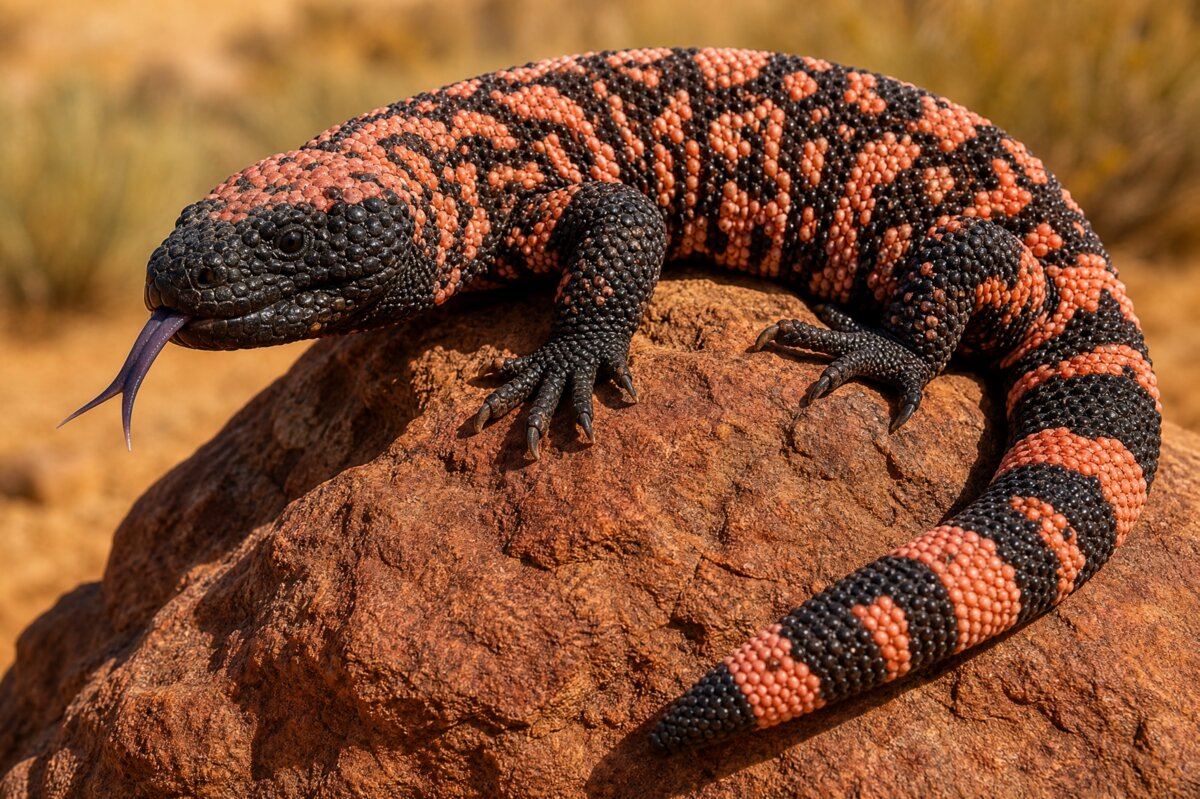
Nothing else in the American desert looks like this. Up to about two feet of stout, unhurried lizard, wrapped in black skin blotched and banded with pink, orange, or salmon, every scale a small bony bead — osteoderms, essentially armor that grew into the skin. The Mojave has its own version, the banded Gila monster, whose markings run in cleaner alternating bands. The tail is short and thick, and deliberately so: it is a pantry. The bright pattern isn't camouflage in the usual sense; it's a warning label, and it works. Gila monsters move at the pace of something that has never had to run from anything.
Life in the Mojave
This is an animal built around scarcity. It spends roughly 95% of its life underground in burrows, crevices, and caliche caves — including, often, burrows the desert tortoise dug. Above ground it hunts eggs and helpless young: quail nests, woodrat nests, whatever a slow lizard can reach. Then it eats astonishingly, up to a third of its own body weight at once, banks the surplus as fat in its tail, and goes back down. An adult may get through a year on only a handful of substantial meals. The venom is unusual too — no hollow fangs, no fast strike. It flows through grooved teeth in the lower jaw while the lizard chews and holds on, sometimes for minutes. Painful, rarely fatal to humans, and almost never encountered, because Gila monsters would genuinely rather you left.
Why It Matters
In the 1990s, researchers studying that venom isolated exendin-4, a peptide that closely mimics the human hormone GLP-1 but lasts far longer in the body. It became exenatide, FDA-approved in 2005 — the first GLP-1 receptor agonist, and the proof of concept behind an entire generation of diabetes and weight-loss medicine now used by millions. The lizard that people once killed on sight turned out to be carrying part of the answer. Meanwhile, the Mojave marks the northern edge of its range, where urban sprawl, habitat loss, and illegal collection have made a scarce animal scarcer; it's listed Near Threatened by the IUCN and protected from collection throughout its range. Its family has been on this continent since the Cretaceous, and its own beaded armor turns up in fossil deposits near Las Vegas from the end of the Ice Age. It was here first, by a very long way.