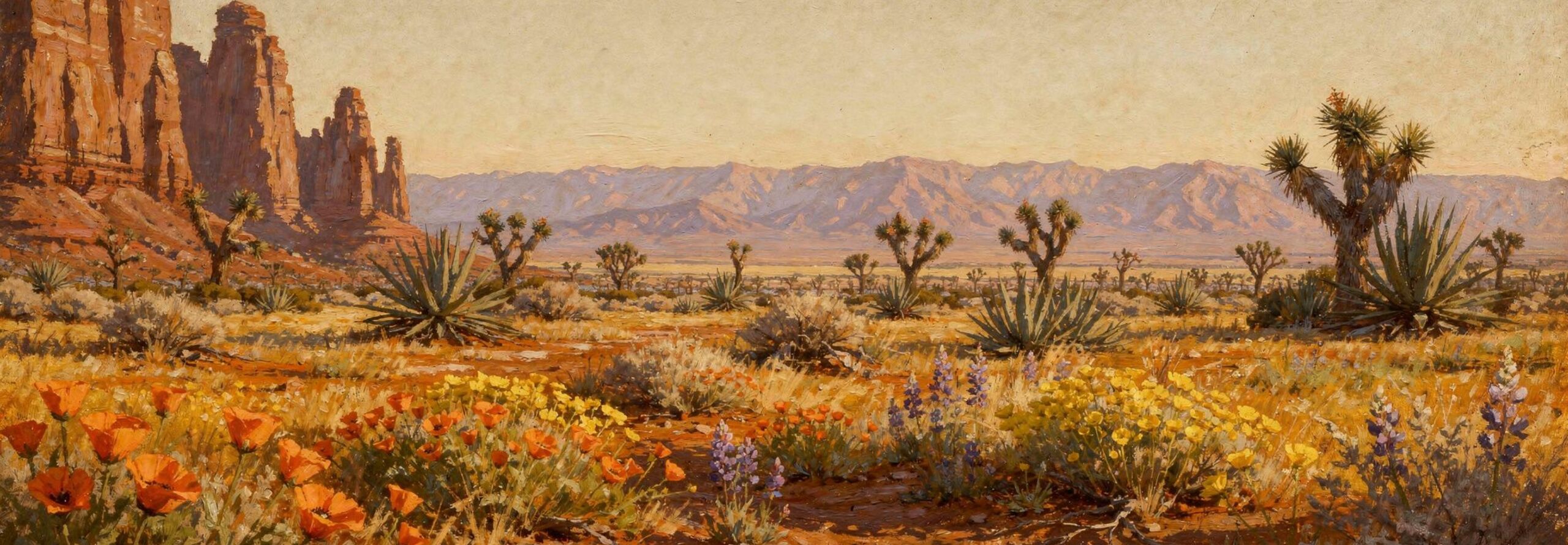
A Joshua tree is not a tree, has no growth rings, and cannot make a single seed without a specific moth showing up to do it by hand. It is also carrying a much older problem: for most of its history, the animal that carried its seeds any real distance was the Shasta ground sloth, which ate the fruit and moved it across the desert. The sloths have been gone about twelve thousand years. Since then the trees have relied on rodents burying seeds a few feet at a time, which is why a warming Mojave is such a hard thing for them — the Joshua tree is trying to move north on the shortest legs it has ever had.
Who They Are
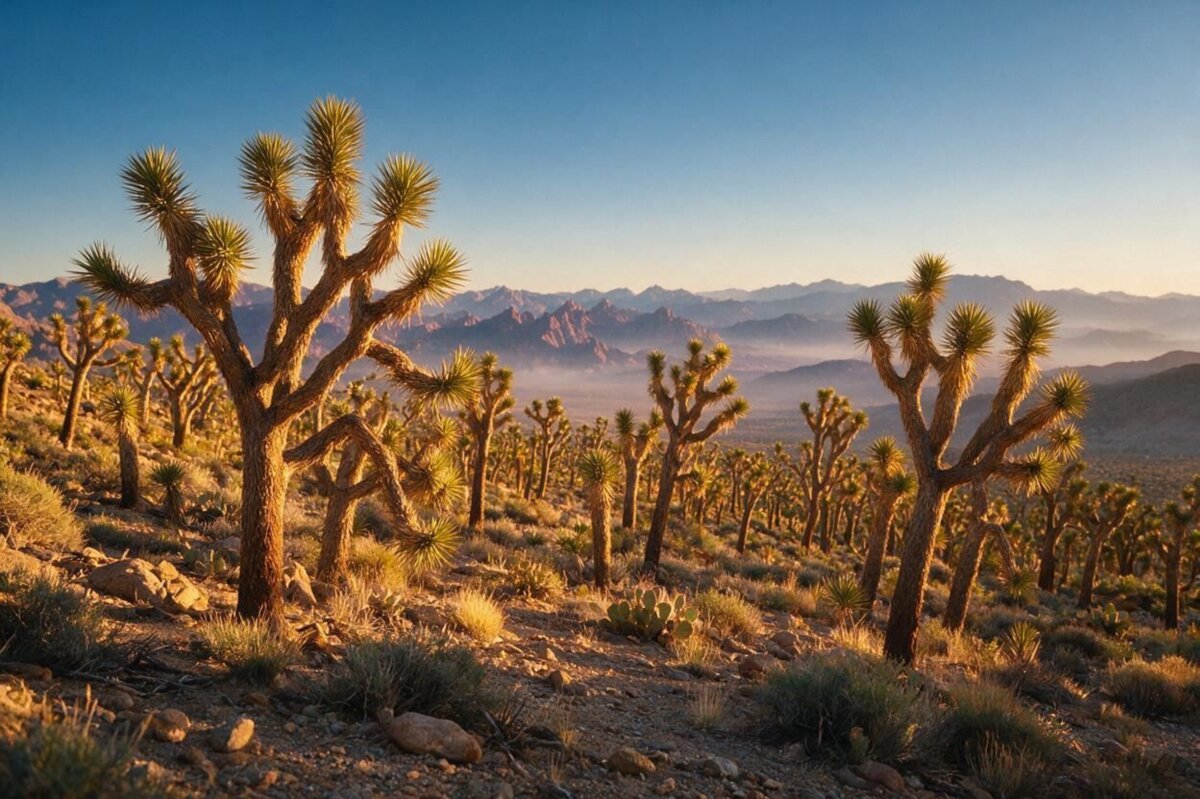
The plant that defines the Mojave Desert is not, botanically speaking, a tree at all. The Joshua tree is a monocot in the agave family, closer kin to grasses and lilies than to oaks, and it grows accordingly: no true bark, no annual growth rings, no reliable way to read its age from a cross-section. What it has instead is architecture — a thick fibrous trunk, arms branching at improbable angles after each flowering, and dense tufts of stiff, dagger-shaped leaves at every branch tip. Ecologists use its distribution to draw the boundaries of the Mojave itself, which is a fair summary of its importance: where Joshua trees stand, you are in the Mojave.
Life in the Mojave
Everything about the Joshua tree runs on partnerships and patience. Its pollen is too heavy for wind, so the entire species depends on a single insect: the female yucca moth, who gathers pollen with mouthpart tentacles found on no other moth, carries it to another tree, and packs it into the flower deliberately — then lays her eggs in the flower she just pollinated, so her larvae can eat a share of the resulting seeds. Neither species can complete its life cycle without the other. Meanwhile, above and below, the tree is an entire neighborhood: Scott's orioles hang nests in the branches, ladder-backed woodpeckers drill the trunk, desert night lizards shelter under fallen limbs, woodrats haul the fibers home for building material, and ground squirrels climb up after the fruit. Roots spread wide and shallow to catch rain before it evaporates. It is a plant built to wait.
Why It Matters
The Joshua tree is the Mojave's keystone plant and its signature silhouette, but its most instructive story is about time and loss. For most of its evolutionary history, its seeds were carried long distances by Shasta ground sloths, which ate the fruit whole — a relationship documented from Joshua tree leaves, fruit, and seeds preserved in fossilized sloth dung, first excavated at Gypsum Cave in southern Nevada in the 1930s. Those sloths vanished around 12,000 to 13,000 years ago. Ever since, the tree's seeds have moved only as far as a scatter-hoarding rodent will bury them — inches and feet instead of miles — which severely limits how fast a Joshua tree woodland can shift its range in response to a changing climate. Add the modern pressures NatureServe documents — invasive annual grasses feeding fires the species cannot tolerate — and the picture is of a plant trying to outrun a warming desert on legs it lost at the end of the Ice Age. And it is genuinely ancient: a fossilized trunk of Protoyucca shadishii, a 15-million-year-old ancestor, sits in Joshua Tree National Park's own museum collection, collected in northwestern Nevada where yuccas no longer grow.
Meet the Yucca Moth
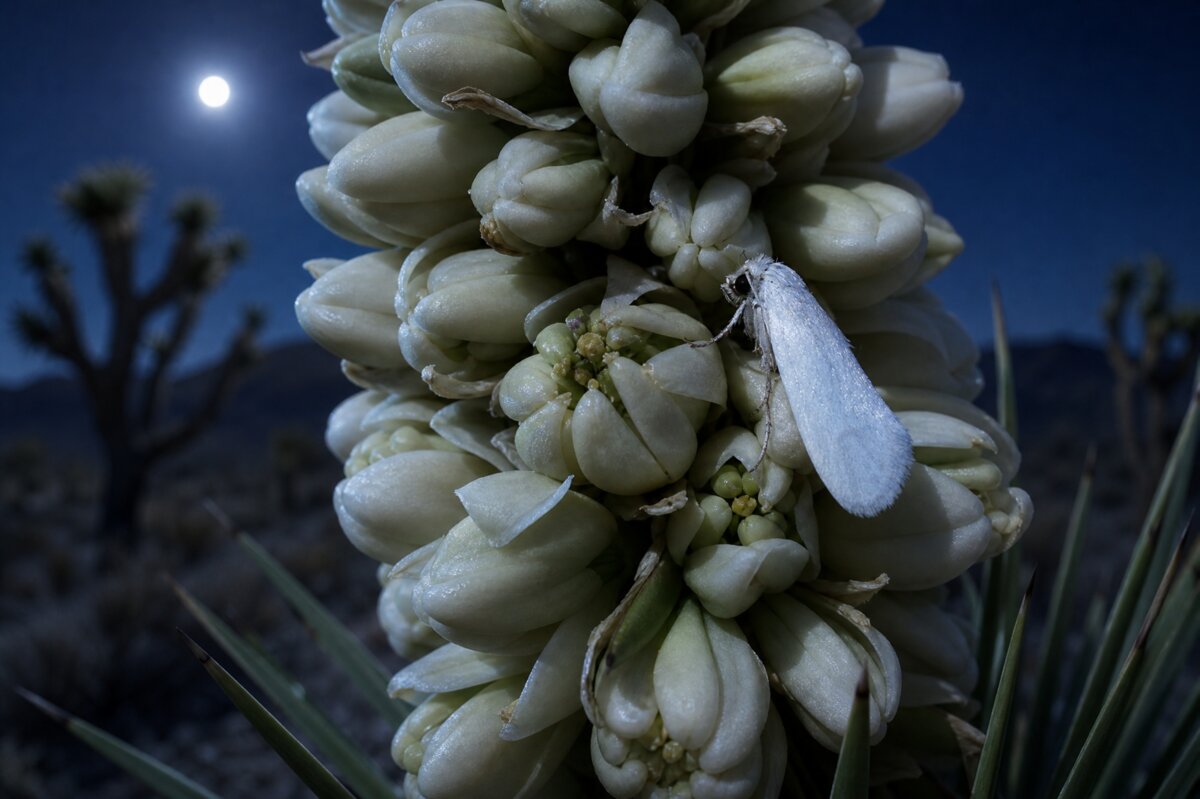
Everything you love about a Joshua tree exists because of a small gray moth working in the dark. Joshua tree pollen is too heavy for wind to move, so the tree has exactly one pollinator: the yucca moth (Tegeticula synthetica), who gathers a ball of pollen with tentacles no other moth on Earth possesses, flies it to a different tree, and packs it deliberately into the flower — then lays her eggs inside, so her young can eat some of the seeds she just made possible. Not too many. Never too many. The entire Mojave skyline depends on a nine-millimeter insect keeping her side of a bargain nobody wrote down.