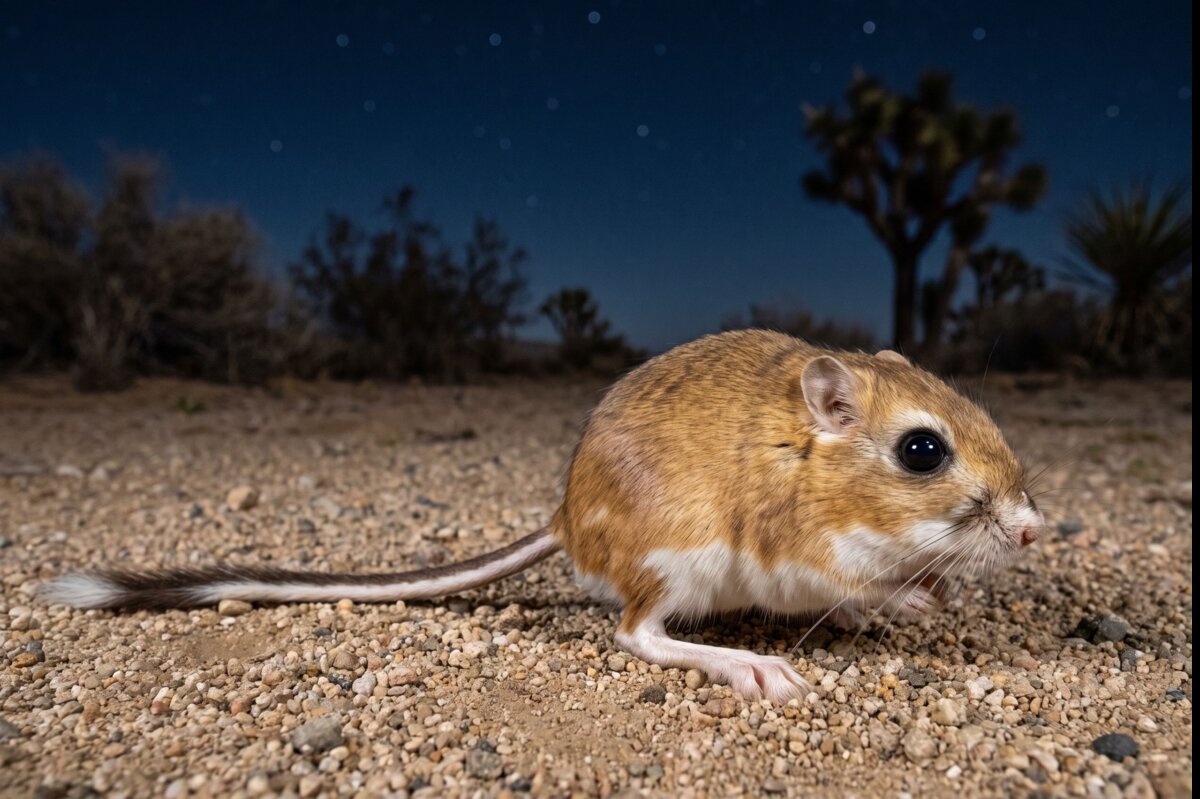
There is an animal out on the dunes tonight that has never had a drink of water and never will. The kangaroo rat eats dry seeds and manufactures its own water from them internally, then guards every molecule: no sweating, no panting, a day spent sealed in a cool burrow, and cheek pouches for hauling groceries home without swallowing them. It hops on two legs like its namesake, steers with its tail, and vanishes in a bound or two when something goes wrong — the Arizona-Sonora Desert Museum credits it with leaps of up to nine feet. It also buries more seeds than it ever comes back for. Half the creosote out there owes it one.
Who They Are
A small, sandy-brown rodent, about 1.2 ounces, with enormous dark eyes, oversized ears, and hind legs entirely out of proportion to the rest of it. It does not run — it hops, bipedally, using a tail longer than its own body as a rudder and counterweight, which is why the whole animal looks like a scale model of something much larger. The face has fur-lined pouches on the outside of the cheeks, opening beside the mouth: portable grocery bags for carrying seeds back to the burrow without swallowing them or wetting them with saliva. It is out only at night. In daylight, it is sealed underground.
Life in the Mojave
The kangaroo rat solves the desert's hardest problem at the cellular level. It eats dry seeds and extracts the water it needs as a metabolic byproduct of digestion. It doesn't sweat or pant — both waste moisture it cannot replace. Its kidneys concentrate urine to an extraordinary degree, losing almost nothing. Seeds cached in its burrow even absorb humidity from the burrow air, so they're less dry by the time they're eaten. Field researchers tracked this species at Kelso Dunes in Mojave National Preserve across fifteen months and found zero signs of physiological stress at any point in the year. It isn't surviving out there. It's comfortable. Nights are spent foraging with one ear tuned for the two things most likely to end it: a barn owl's wingbeat, and the sidewinder waiting in the sand.
Why It Matters
Kangaroo rats are the engine room of the desert food web — the animal that turns seeds into protein for owls, foxes, snakes, and coyotes. But their bigger contribution is agricultural. A kangaroo rat buries far more seed caches than it ever returns to, and the forgotten ones germinate; across generations, this animal has been planting the shrubs that define the Mojave. It also physically remodels the ground, and its burrows shelter other species. As desert-adaptation science, it may be the most instructive small mammal in North America: a creature that solved the hardest problem this landscape poses — no water — so thoroughly that it stopped needing to look for the answer at all.