
There is a five-pound fox out there tonight with ears too big for its head, and both facts are the point. Small body sheds heat fast; huge ears shed more of it and hear a kangaroo rat moving under the sand from across a wash. It sleeps out the day underground and keeps a network of dens scattered across its range, because when your main predator is the coyote, the most valuable thing you own is another exit. Kit foxes mate for life, and last year's kits often stay to help raise this year's. Small, quiet, and running the night shift.
Who They Are
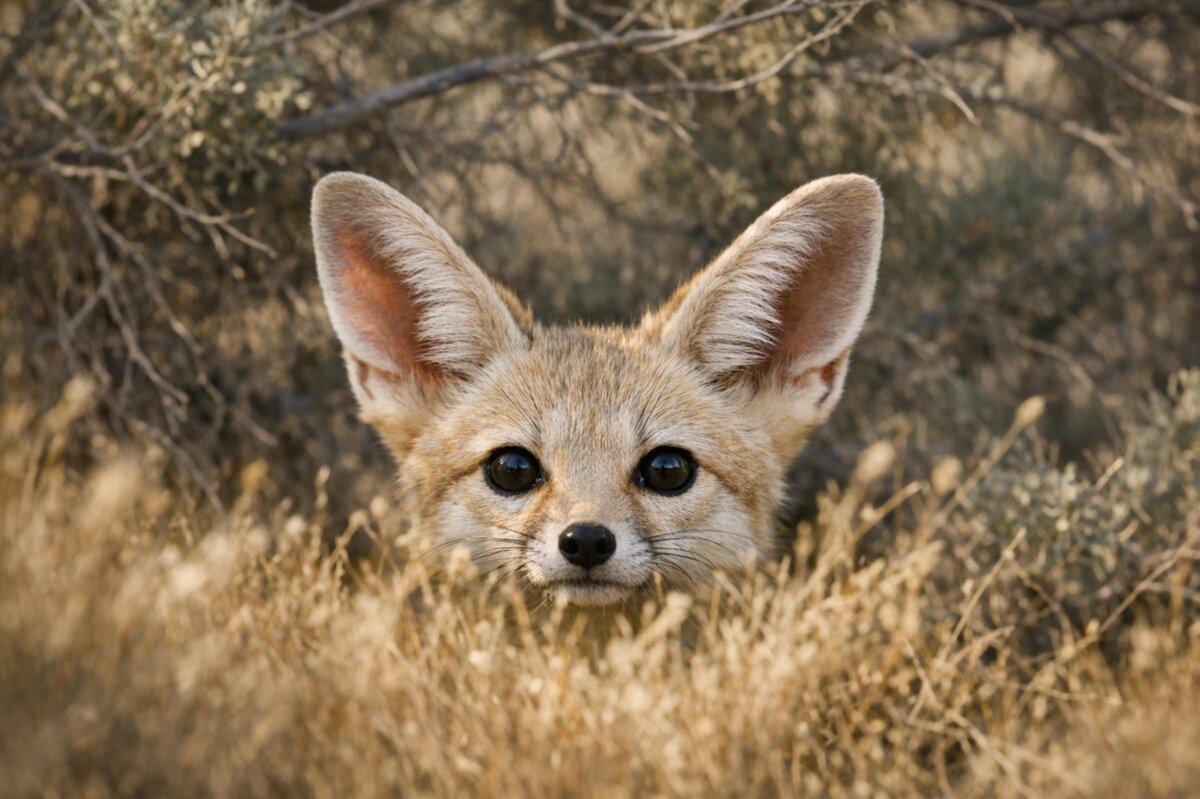
The smallest fox in North America and, proportionally, the biggest-eared — roughly house-cat sized at four to five pounds, in sandy buff and gray, with a narrow muzzle, a slim frame, and a bushy black-tipped tail nearly a third of its total length. The ears are the thing you'll remember: large, close-set, and constantly in motion. It is almost strictly nocturnal, emerging shortly after sunset and hunting through the night, so most people who share a valley with kit foxes never see one — just tracks, and a den entrance in the morning.
Life in the Mojave
Two problems, one solution. The desert is hot, and a small body with oversized ears sheds heat efficiently — the same design logic as Africa's fennec fox, arrived at independently. And prey is scattered and quiet, which is where those ears earn their keep: kit foxes hunt kangaroo rats, other rodents, jackrabbits, and insects largely by sound. The rest of the strategy is real estate. Kit foxes dig their own dens and also take over burrows made by badgers, ground squirrels, prairie dogs, and kangaroo rats, and an individual fox typically uses more than eleven dens in a single year, spread across its range. Dens handle everything at once — daytime heat, moisture conservation, predator escape, and pup rearing. That redundancy matters because the kit fox's most serious predator is the coyote, an animal five to ten times its size that shares the same ground. Socially they're gentler than the arithmetic suggests: pairs typically mate for life, live in small family groups rather than defending hard territories, and young females sometimes stay an extra year to help raise the next litter.
Why It Matters
The kit fox is the Mojave's night-shift predator on small mammals, a check on rodent populations that operates entirely in the hours nobody's watching. It's currently Least Concern rangewide and State Protected in Nevada, but the trend is downward, and the reason is unglamorous: habitat loss to agriculture, development, and roads. The California subspecies, the San Joaquin kit fox, has been federally Endangered since 1967 — a warning about what happens when open valley floor is converted faster than a den-dependent animal can relocate. It's a small animal with a small margin, running an enormous desert on five pounds and good hearing.