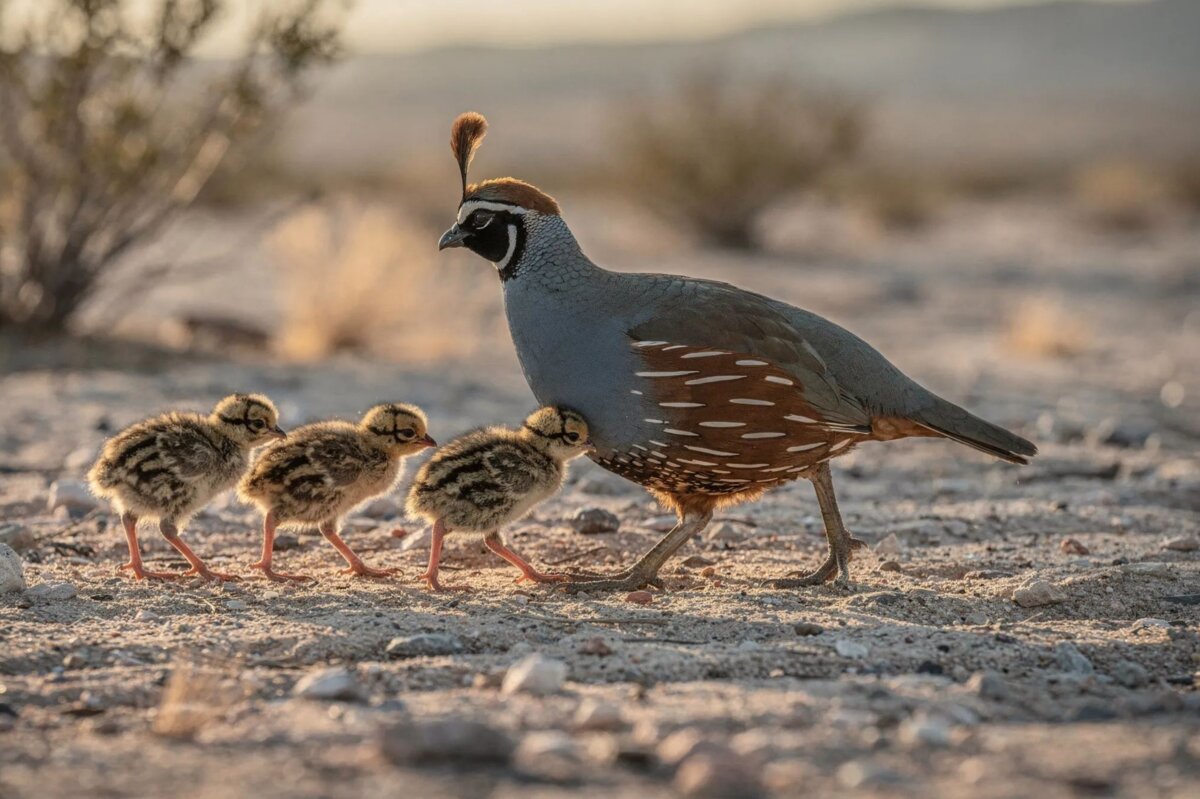
You will hear a covey of Gambel's quail before you see it, and then you will see all of it at once — a dozen small round birds bursting out of the brush and running, topknots bobbing, into the next bush. They are family units — an adult pair plus the season's young — and in winter, whole families fuse into gatherings of several dozen. The young are working almost immediately: a quail chick can walk, peck up a seed, and keep up with the family within a day of hatching. No long helpless childhood out here. The desert doesn't offer one.
Who They Are
Plump, gray-blue, and ridiculous in the best way, Gambel's quail is about the length of a school ruler and light enough to sit in your palm. Both sexes wear the forward-curling black topknot that bobs with every step; males add a chestnut cap, a black face and throat, and a black belly patch, and the flanks are chestnut streaked with white. The voice carries — a rising, questioning gathering call used to keep the covey together, plus a fast alarm chip. They are ground birds by preference and by conviction: when startled, a Gambel's quail runs for cover, and only flies if running has failed.
Life in the Mojave
They live in coveys — an adult pair with the season's young, and larger gatherings of a dozen or more outside breeding season — feeding through the day on seeds, leaves, mesquite pods, and cactus fruit, with insects mattering more for growing chicks. Much of their water comes from succulent vegetation, though coveys will walk to water in the morning and evening where it exists. While the group feeds, one bird typically takes a high perch and watches, which is a reasonable investment given the list of things that eat quail: Cooper's and Harris's hawks, coyotes, bobcats, snakes, and any lizard large enough to find a ground nest. The nest itself is barely a nest — a scrape at the base of a shrub or rock holding ten to twelve eggs, incubated about three weeks. And then those chicks hit the ground running, literally, within a day. Audubon notes that two hens sometimes even lay in the same nest, and in fall and winter, family groups fuse into coveys of several dozen birds.
Why It Matters
Gambel's quail is one of the desert's great seed movers and one of its most reliable prey species — an animal near the base of the food web that a lot of the Mojave's predators depend on. It's also one of the few desert natives that has managed the arrival of cities gracefully, moving into the brushy edges of southwestern suburbs and taking scattered grain in back yards without losing any of its wildness. Populations rise and fall with rainfall, which makes them a decent readout on how a given desert year actually went. And the name is a small memorial: William Gambel, the young naturalist who first reported them, died at 28 crossing the Sierra Nevada in winter. The birds have done better than he did.