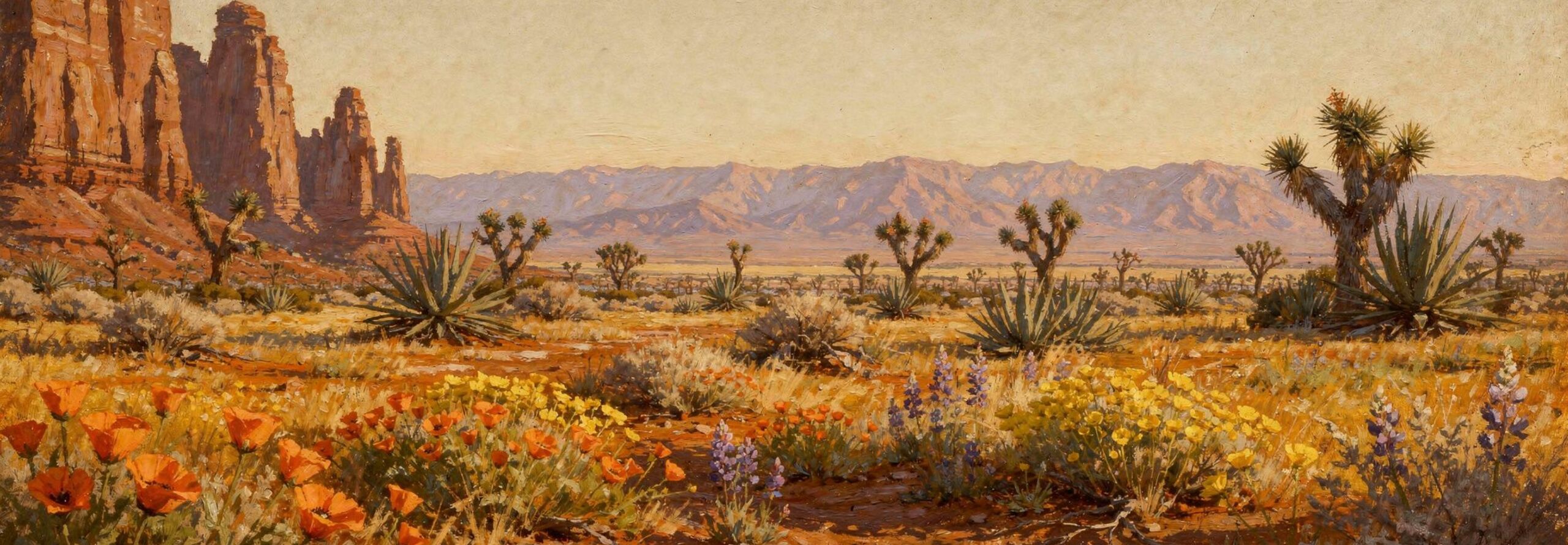
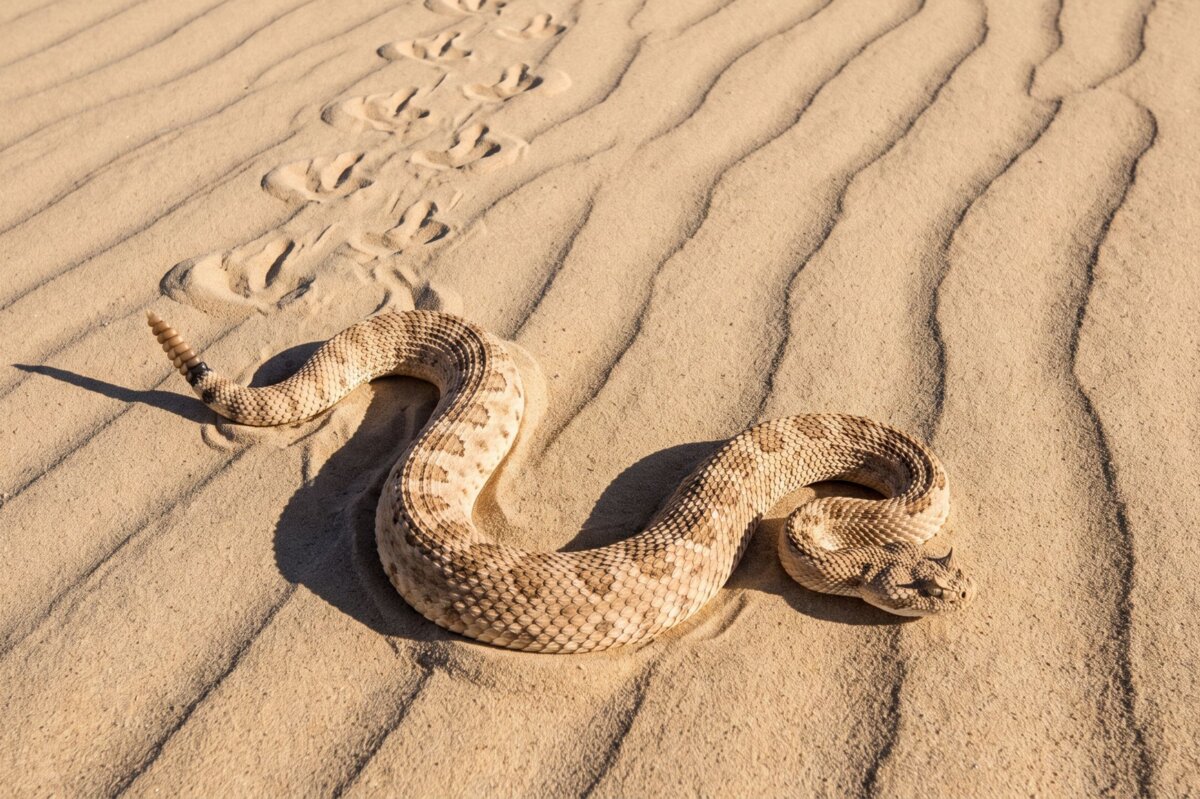
Sand is a terrible thing to walk on and an even worse thing to have no legs on. The sidewinder's solution is to throw its body forward in loops, touching down at only two points at a time, moving sideways across dunes that would swallow a snake traveling the ordinary way — and leaving those unmistakable parallel J-marks behind. It hunts at night, buries itself in sand until only its eyes show, and waits. Two other snakes on two other continents worked out the same trick independently. Some problems only have one good answer.
Who They Are
A small rattlesnake — most adults under two and a half feet — colored exactly like the sand it lives on, in pale tan, cream, and soft pink-brown. The name that isn't official is horned rattlesnake, for the raised scales that stand up over each eye like a pair of small brows. It is a pit viper, with the heat-sensing pits between eye and nostril that let it find a mouse in complete darkness. But what you'll actually notice is how it moves. Sidewinding looks nothing like normal snake travel: the body throws itself forward in lifted loops, only two sections touching the ground at a time, so the animal appears to be moving sideways at an angle to the way it's pointing. Behind it, a run of neat parallel J-shaped bars.
Life in the Mojave
Everything here is about heat and loose ground. Sand shifts under a normal snake's push, and midday sand can kill; sidewinding solves both, minimizing contact with scorching ground while gripping shifting dune surfaces. Biomechanics researchers who filmed sidewinders on natural sand found the snakes lift their bodies substantially higher on sand than on smooth lab flooring — the gait tunes itself to the surface. It hunts mostly at night and at dusk, taking kangaroo rats, lizards, and the occasional bird, and it hunts by ambush: a shimmying motion works the body down into the sand until little more than the eyes and the top of the head are exposed, and then it waits — patiently, sometimes for days — for something warm to walk past. The rattle is small and the temperament shy; most people who share this desert with sidewinders will never see one.
Why It Matters
The sidewinder is the Mojave's dune specialist, the predator that keeps rodent populations in check in the one terrain most animals can't work. Its story is also one of evolution's best demonstrations: sidewinding turned up independently in the Saharan horned viper of North Africa and Peringuey's adder in the Namib — three unrelated snakes on three continents, all handed the same problem of hot loose sand, all arriving at the same strange sideways answer. It's currently listed Least Concern, which in a desert of threatened species is a small mercy. The tracks are the easiest way to know it was there: two parallel bars in the sand, pointing one direction, made by an animal that went another.